AI-NATIVE SERIES · PITCHING AGENTIC AI, PART 2 OF 3
Selling Agents This Season: Bounded, Accountable, Evidence-Led
1-minute takeaway
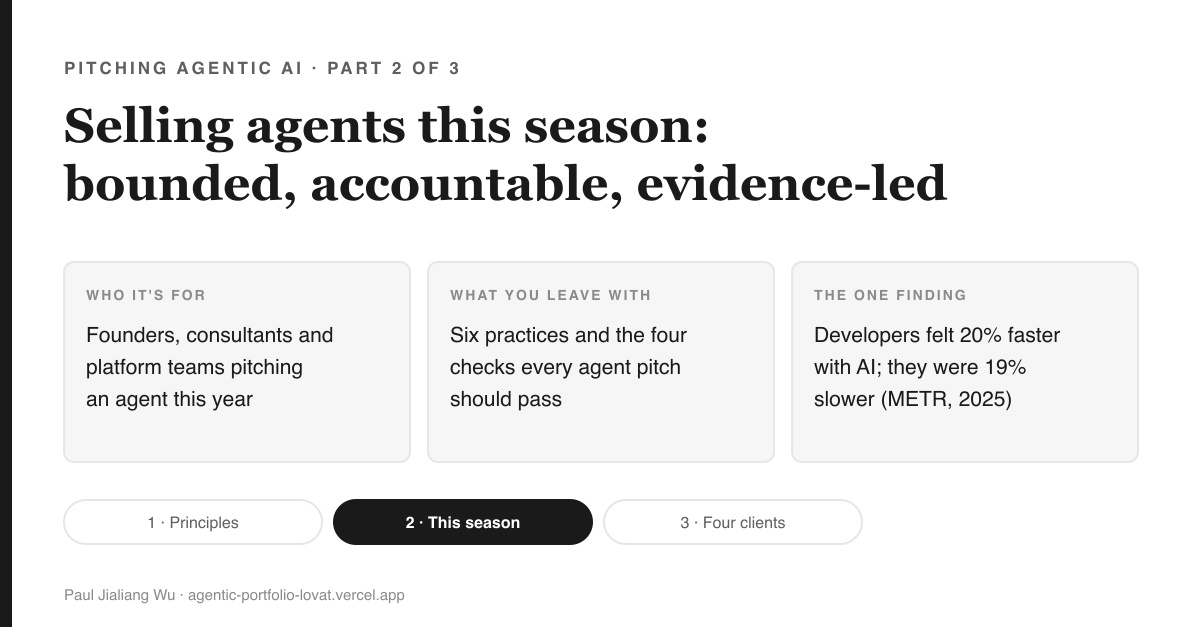
What this is. Part 2 of the series: this season's practice for pitching AI agents, and four checks every pitch should pass: specific, sized honestly, owned by a person, measured in advance.
Why it matters. In a 2025 randomised trial, experienced developers were 19% slower with AI tools and still believed they were 20% faster (METR). A broad productivity promise is the claim the evidence supports least.
What you can do after reading. Run your four lines through the four checks, then write one sentence for the person who can say no: what the agent can touch and who approves.
Pitching Agentic AI — the series spine
- Principles that outlast every pitch episode 1
- Selling agents this season this episode
- Four clients, four first workflows episode 3
How to read the labels: EVIDENCE is sourced, DESIGN is a recommended practice, OPEN is not yet tested, and LENS is my own conviction.
Enterprise AI pilots often stall, and how they're scoped is a large part of why. Six practices for 2025–26, built around one idea: pick one stuck workflow, and let a paired measure agreed in advance do the selling. The surprise: the best trials of AI coding tools disagree.
What this episode covers: how to pitch an AI agent right now
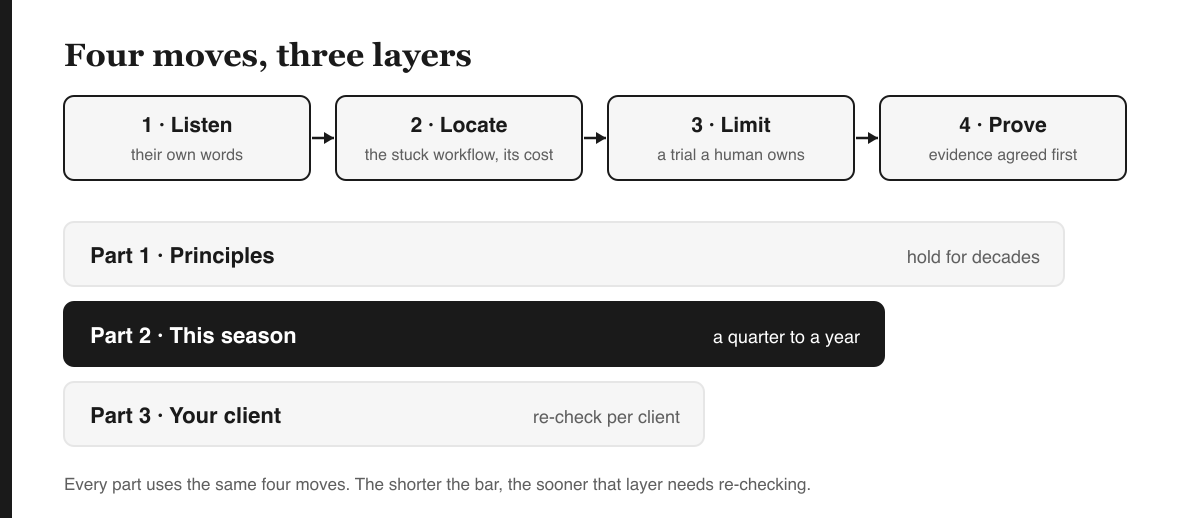
Part 1's principles barely move. This layer moves every year or so: how buyers buy, what the evidence currently says, and what they ask about governance. It is for anyone pitching an agent into an enterprise this year, whether a startup founder, a consultant or an internal platform team. I work at Accenture, which appears in one of the studies below; I say so where it comes up. Everything here is my own synthesis from public sources.
Make a bet first
In a 2025 randomised trial, experienced open-source developers worked on real tasks in their own repositories, with and without AI tools. Before starting they predicted AI would make them about 24% faster. With AI, their tasks took:
- A. About 20% less time.
- B. About the same time.
- C. About 19% more time.
Practice 1: qualify before you pitch
EVIDENCE Enterprise sales formalised this long ago. MEDDIC, a checklist practitioners trace to PTC in the 1990s, asks for metrics, an economic buyer, decision criteria, a decision process, the pain, and a champion. Its origin story is practitioner lore and unverified in detail, but it survives for a plain reason: a deal with no owner and no agreed measure rarely closes, however good the demo.
DESIGN For an agent trial I add four questions of my own. Is there a named owner for the result? Can the team give access and context? Is there a reviewer with time to judge the output? Is the work repeatable enough to scope, with a way to check it? Missing one is a reason to pause and find it, not to push on.
Practice 2: pick one workflow under pressure
DESIGN Stuck engineering work tends to look like one of four things. I call them the four Rs:
| Stuck work looks like | Typical symptom | A bounded first task | |---|---|---| | Waiting | reviews and approvals queue up | first-pass review against the team's own checklist | | Redoing | rework, flaky tests, re-run pipelines | triage failing CI runs for one service | | Relearning | context lost between people, old code nobody knows | explain and document one legacy module, read-only | | Re-explaining | handoffs, stale docs, repeated questions | draft a runbook from one incident's history |
Pick one row, for one team. Not as narrow as autocomplete, and not as broad as company-wide automation, which is just slide 7 with a budget.
Practice 3: speak to each person who can say yes, or no
DESIGN The same stuck workflow means something different to each of four people:
- The budget owner (CTO, VP of engineering): capacity, quality, release confidence.
- The platform owner: consistency, developer experience, less repeated investigation.
- The dates owner (product): fewer slipped commitments, more predictable releases.
- The person who can say no (security, risk, quality): what the agent can touch, who approves, what's logged.
Most pitches address the first three. In the deals I've watched stall, it was usually the fourth person, who never got a sentence.
Practice 4: claim only what the evidence supports
EVIDENCE Back to the bet: the answer is C. In METR's 2025 randomised trial (16 experienced developers, 246 tasks in their own repositories), allowing AI tools made tasks take 19% longer, and the developers still believed afterwards that AI had made them about 20% faster (Becker et al., METR, 2025). METR later said a re-run gave only a weak signal, because many developers would no longer work without AI, and that it now thinks developers are likely sped up more than before (METR, Uplift update, Feb 2026).
EVIDENCE The other side: field experiments at three companies, including Accenture (my employer), with 4,867 developers found about 26% more completed tasks (pull requests, not "productivity") with an AI code-completion tool, with less experienced developers gaining more (Cui et al., The Effects of Generative AI on High-Skilled Work, 2024–25). Google's DORA 2025 survey of about 5,000 professionals found AI use tied to higher throughput but still to lower delivery stability: AI amplifies what's already there (DORA 2025 announcement).
DESIGN These don't contradict each other once you read them by setting and by era: code completion for a broad population in 2022–23, experienced developers in mature codebases with early-2025 tools, and whole delivery systems. That is why "developer productivity" is the wrong promise, and a workflow-specific claim with an agreed measure is the honest one.
Practice 5: pair a speed signal with a quality signal
EVIDENCE Whether a pilot reaches production depends heavily on how it is built. MIT NANDA's 2025 study, based on interviews, surveys and public implementations, reported that "external partnerships with learning-capable, customized tools reached deployment ~67% of the time, compared to ~33% for internally built tools," and itself notes the figures are self-reported (MIT NANDA, The GenAI Divide, 2025; a widely circulated copy of the report). Its often-quoted "95%" counts organisations getting zero return, not failed pilots.
EVIDENCE Vendors are moving pricing towards outcomes: Intercom charges $0.99 per resolution for its Fin agent (Intercom pricing), and Salesforce prices Agentforce per conversation or per action (Agentforce pricing). Each vendor defines "outcome" itself.
DESIGN This is the Prove move with teeth. Agree a speed signal and a quality signal together, with the bar and who reads them: review turnaround with escaped defects, documentation time with tests accepted unchanged. Speed alone is gameable. Reviews get faster by getting shallower, and everyone celebrates until the incident review.
Practice 6: let the trial's shape answer governance
EVIDENCE Buyers now arrive with a governance checklist. The EU AI Act has applied obligations for general-purpose AI models since August 2025 (EU AI Act implementation timeline), and NIST's AI Risk Management Framework is the common US reference (NIST AI RMF).
DESIGN A limited trial answers most governance questions by its shape. Say what the agent can touch, who approves each output, what is logged, and when a specialist will check configuration and controls. If the answer to "what can it touch?" takes a paragraph, the trial is too big.
Four checks before you pitch
- Specific: one workflow, one team.
- Sized honestly: "may be worth evaluating", not a promised transformation.
- Owned by a person: engineers keep responsibility for quality and approvals.
- Measured in advance: a speed and a quality signal, with a bar, agreed before starting.
How this could fail
- The evidence is moving. METR revised its own picture within months. Any number here may be out of date when you read it, so check the date before quoting it.
- Qualification can become an excuse. "Not ready" is sometimes true and sometimes a seller avoiding a hard account. Write down which question failed and when you'll ask again.
- The fourth person still says no. It is an open question how quickly enterprises will settle their AI policies; a limited trial helps, but it doesn't remove the wait.
- The four Rs are my lens, not a law. They sort the stuck work I have seen; your client's may not fit, and that's worth knowing early.
Your move this week
Take the four lines you wrote in part 1. Run them through the four checks. Then write one sentence for the person who can say no: what the agent can touch and who approves. If you can't write it, you aren't ready to propose a trial.
Next
Part 3 tailors all of this for four industries where mistakes are most expensive: financial services, life sciences, industrial manufacturing, and technology and telecom. Each gets the pain, the owner, the rules, and a first workflow that fits.
Sources
- Becker, J., et al. "Measuring the Impact of Early-2025 AI on Experienced Open-Source Developer Productivity." METR, arXiv:2507.09089, July 2025.
- METR. "Uplift update." 24 February 2026.
- Cui, Z., Demirer, M., Jaffe, S., Musolff, L., Peng, S., Salz, T. "The Effects of Generative AI on High Skilled Work: Evidence from Three Field Experiments with Software Developers." SSRN 4945566 (2024; revised 2025).
- Google Cloud. "Announcing the 2025 DORA report." 23 September 2025.
- MIT NANDA. "The GenAI Divide: State of AI in Business 2025." July 2025.
- Intercom, pricing page; Salesforce, Agentforce pricing page. Both checked October 2026; prices change often.
- EU AI Act implementation timeline (artificialintelligenceact.eu); NIST AI Risk Management Framework 1.0, January 2023.
- Provenance: prompted by a coding-agent enablement session the author attended in 2026; the practices, table and checks are the author's own synthesis from the public sources above.