AI-NATIVE SERIES · PITCHING AGENTIC AI, PART 3 OF 3
Four Clients, Four First Workflows
1-minute takeaway
What this is. Part 3 of the series: a bounded first workflow for four client categories, with the rules that bind each, including SR 26-2, which replaced SR 11-7 for US bank model risk in April 2026.
Why it matters. Clients differ most in what they're not allowed to get wrong. A trial the gatekeeper can approve quickly beats a better one they can't.
What you can do after reading. Fill in one row of the article's table for your next client, then show it to the gatekeeper and ask what would stop them approving it.
Pitching Agentic AI — the series spine
- Principles that outlast every pitch episode 1
- Selling agents this season episode 2
- Four clients, four first workflows this episode
How to read the labels: EVIDENCE is sourced, DESIGN is a recommended practice, OPEN is not yet tested, and LENS is my own conviction.
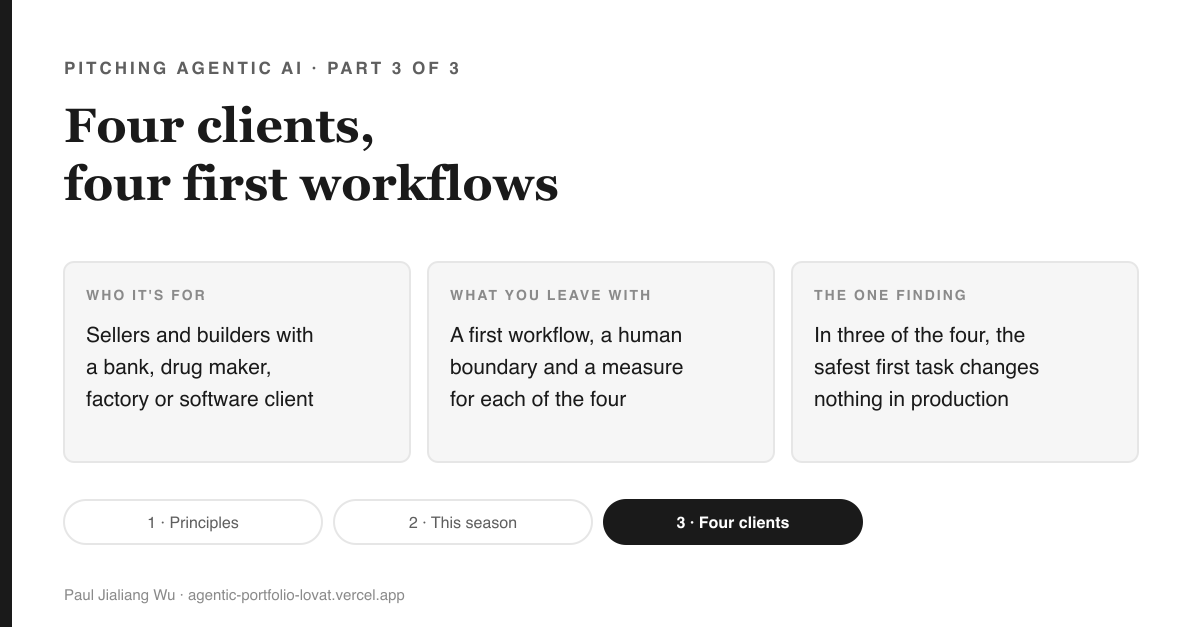
The same four moves land differently in a bank, a drug maker, a factory and a software company. For each: the pain, its owner, the rules, and one six-week first workflow with a human boundary and a paired measure. The surprise: in three of the four, I'd keep the first task out of production entirely.
What this episode covers: a first workflow for four industries
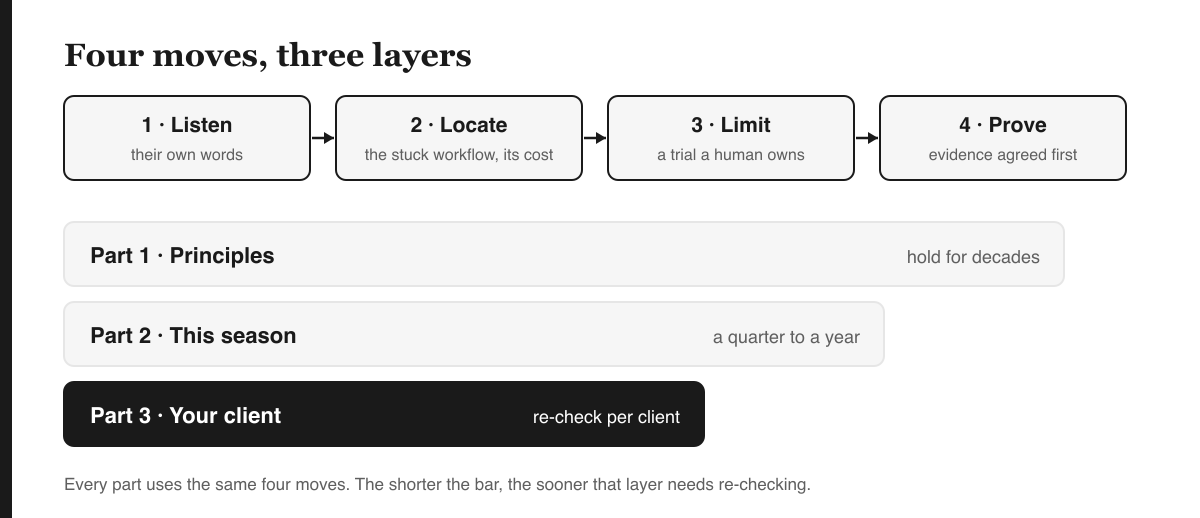
Parts 1 and 2 gave the moves (listen, locate, limit, prove) and four checks (specific, sized honestly, owned by a person, measured in advance). They still have to meet a real client, and clients differ most in what they're not allowed to get wrong. This episode picks four industries where mistakes are most expensive. For each it proposes a first workflow: small enough to try in six weeks, visible enough to judge, and inside the rules.
These are starting hypotheses, not advice for any specific firm. Regulation varies by jurisdiction and changes often; check every rule below with the client's own risk, quality or legal team before you rely on it.
Make a bet first
Of these four kinds of client (a bank, a life-sciences company, an industrial manufacturer, a software company), in how many would you keep an AI agent's first task out of production entirely?
- A. One.
- B. Two.
- C. Three.
Unlike parts 1 and 2, there's no study behind this bet. It's a judgement call, and I'll show mine.
1. Financial services and insurance
The pain. EVIDENCE Every model that informs a decision needs evidence for the model-risk team, and that guidance has just changed. In April 2026 the Federal Reserve issued SR 26-2, interagency guidance with the OCC and FDIC that "supersedes and replaces" SR 11-7, and is "expected to be most relevant to banking organizations with over $30 billion in total assets" (Federal Reserve, SR 26-2, 2026). In the EU, the Digital Operational Resilience Act (EU DORA, not to be confused with Google's DORA metrics in section 4) has applied since January 2025, covering ICT risk, third-party risk and resilience testing (EIOPA, DORA).
Who owns it. The CIO or head of engineering buys. The model-risk officer, CISO and vendor-risk team decide whether it can run.
First workflow. DESIGN Document and generate tests for one non-production legacy batch module. Engineers review every change; nothing reaches production in the trial. (The model-risk team has seen slide 7. They wrote a policy about it.)
Measure. In week one, record how long documenting a module takes today. Over six weeks, compare, paired with the share of generated tests engineers accept unchanged.
The pitch. You've said modernisation is blocked by knowledge locked in old code (listen). The recurring cost is the weeks a senior engineer spends just reading it (locate). One module, read-only, your engineers approving every test (limit). If documentation time halves against week one and most tests are accepted, it may be worth a second module (prove).
OPEN Whether SR 26-2's attached guidance treats coding agents differently from decision models is an open question I haven't resolved. Ask the model-risk team in the first meeting, not the last.
2. Life sciences and healthcare
The pain. EVIDENCE Software that touches regulated records has to be validated, and electronic records and signatures fall under 21 CFR Part 11 (eCFR, 21 CFR Part 11). FDA's final Computer Software Assurance guidance (February 2026), written for production and quality-system software at device manufacturers, is widely read across life sciences as a signal towards risk-based assurance instead of exhaustive scripted testing (FDA, Computer Software Assurance).
Who owns it. The head of R&D IT or quality IT buys. Quality assurance and the validation team are the gatekeepers.
First workflow. DESIGN Draft validation test scripts and a traceability matrix for one low-risk, GxP-adjacent internal tool. QA reviews and signs every artifact; no patient data enters any prompt; nothing from the trial is used in production; approved scripts are kept as evidence for the next tool.
Measure. Days from requirement to an approved test script, against a week-one baseline, paired with QA's rejection rate on first review.
The pitch. You've said validation is the bottleneck on every tool release (listen). The repeat cost is drafting scripts from scratch each time (locate). One low-risk tool, drafts only, QA signs everything (limit). If approval time falls and first-pass rejections don't rise, it may be worth a second tool (prove).
LENS Here, accountability for records and signatures is a legal requirement, not a courtesy. Saying so first earns more trust than any benchmark.
3. Industrial and manufacturing
The pain. EVIDENCE The installed base is large: China's operational stock of industrial robots alone passed 2 million in 2024, by the International Federation of Robotics' count (IFR, World Robotics 2025), and, in my experience, the control software around such equipment often outlives the people who wrote it. OT security has its own standard family, IEC 62443 (ISA, IEC 62443).
Who owns it. The VP of engineering or digital manufacturing buys. The OT security lead decides what anything may connect to.
First workflow. DESIGN Explain and document legacy control or SCADA code, read-only, and generate tests that run only in a simulator or digital twin. The boundary is absolute: no AI-written code goes into safety-rated logic, the territory of functional-safety standards such as IEC 61508.
Measure. Time for an engineer new to a line to understand a control routine, against how long the last new engineer took (record it in week one), paired with defects found in simulation before any change reaches the line.
The pitch. You've said only two people still understand that line's controller code (listen). Every change waits for them (locate). Read-only explanations and simulator-only tests, nothing near safety logic (limit; no plant manager has ever asked for less caution around an interlock). If a new engineer gets up to speed twice as fast without a missed defect, it may be worth a second line (prove).
4. Technology, software and telecom
The pain. EVIDENCE AI raises throughput but can lower delivery stability, as Google's DORA 2025 report found, and review becomes the bottleneck (DORA 2025 announcement).
Who owns it. The CTO and the platform engineering lead. Product owns the roadmap dates that slip.
First workflow. DESIGN Test backfill for one service, or first-pass pull-request review against the team's own checklist, with engineers approving every merge. This is the one industry where I'd let the first task write code that ships, because the team already owns the pipeline that catches mistakes.
Measure. DORA's own metrics before and after: deployment frequency, lead time for changes, change failure rate and time to restore (noisy over six weeks for one service, so read the trend, not the number). Pair review turnaround with escaped defects, so speed can't come from shallower review.
The pitch. You've said review is where releases queue (listen). The same checklist gets applied by hand, inconsistently, every sprint (locate). One service, first-pass review, engineers approving every merge (limit). If turnaround drops and change failure rate holds, it may be worth a second service (prove).
The pattern across all four
| Industry | First workflow | Human boundary | Speed signal | Quality signal | |---|---|---|---|---| | Financial services | document and test one legacy module | engineers approve every test; nothing in production | hours to document | tests accepted unchanged | | Life sciences | draft validation scripts for one low-risk tool | QA signs every artifact; no patient data; nothing in production | days to an approved script | QA first-pass rejections | | Industrial | explain control code; simulator-only tests | simulator only; nothing in safety-rated logic or production | time to understand a routine | defects found in simulation | | Software and telecom | test backfill or first-pass review | engineers approve every merge | review turnaround, lead time, deploy frequency | change failure rate, escaped defects |
My answer to the bet is C: three of the four stay out of production entirely. DESIGN The mechanism, as I see it: a gatekeeper's first question is rarely "how good is it?" but "what is the worst it can do?" Keeping the trial out of production makes that answer "nothing", and "nothing" is the only answer a gatekeeper can approve before there is evidence. That's a design judgement, not a measurement, and in each case the gatekeeper is the one who rules on it. In regulated and safety-critical settings, a trial that changes nothing in production is the one gatekeepers can approve quickly, and it builds the evidence that later earns more.
How this could fail
- The categories are coarse. A digital-native bank behaves more like a software company than a regional insurer. Qualify the client, not the industry label.
- Regulation moves faster than articles. SR 26-2 replaced a 2011 guidance this year; EU high-risk AI timelines have shifted. Check every rule's current status before you cite it to a client.
- Out of production can become a dead end. If nobody owns the step from "explains the code" to "changes it safely," the trial ends as documentation. Name that owner before you start.
- We don't know the base rates. I have no reliable figure for how often trials like these convert to production in each industry. Count your own, honestly, including the ones that fail.
- Slide 7 sneaks back in. Each industry tempts a capability list of its own ("and it also does compliance!"). One workflow. One team. Six weeks.
Your move this week
Pick the industry closest to your next client. Fill in one row of the table above for them, using the client's own words for the pain. Then show the row to the gatekeeper, not the buyer, and ask one question: "What would stop you approving this?"
Next
That completes the series: principles that outlast every pitch, the practices of this season, and a first workflow for four industries. The season layer will change as the evidence does; the principles in part 1 are the part I expect to keep.
Sources
- Board of Governors of the Federal Reserve System. SR 26-2, "Revised Guidance on Model Risk Management" (interagency with the OCC and FDIC). 17 April 2026.
- EIOPA. Digital Operational Resilience Act (Regulation (EU) 2022/2554), applying from 17 January 2025.
- US eCFR. 21 CFR Part 11, Electronic Records; Electronic Signatures.
- US FDA. "Computer Software Assurance for Production and Quality Management System Software." Final guidance, February 2026 (docket FDA-2022-D-0795).
- International Federation of Robotics. World Robotics 2025, press release.
- ISA. ISA/IEC 62443 series of standards. IEC 61508, functional safety of electrical/electronic/programmable electronic safety-related systems.
- Google Cloud. "Announcing the 2025 DORA report." 23 September 2025.