AI-NATIVE SERIES · DESTINATION, NOT TOOLBOX, EPISODE 2 OF 3 · PRINCIPLE 2
OEC Loops at Every Scale: How a Codebase (and a Team) Keeps Improving Without Being Reminded
1-minute takeaway
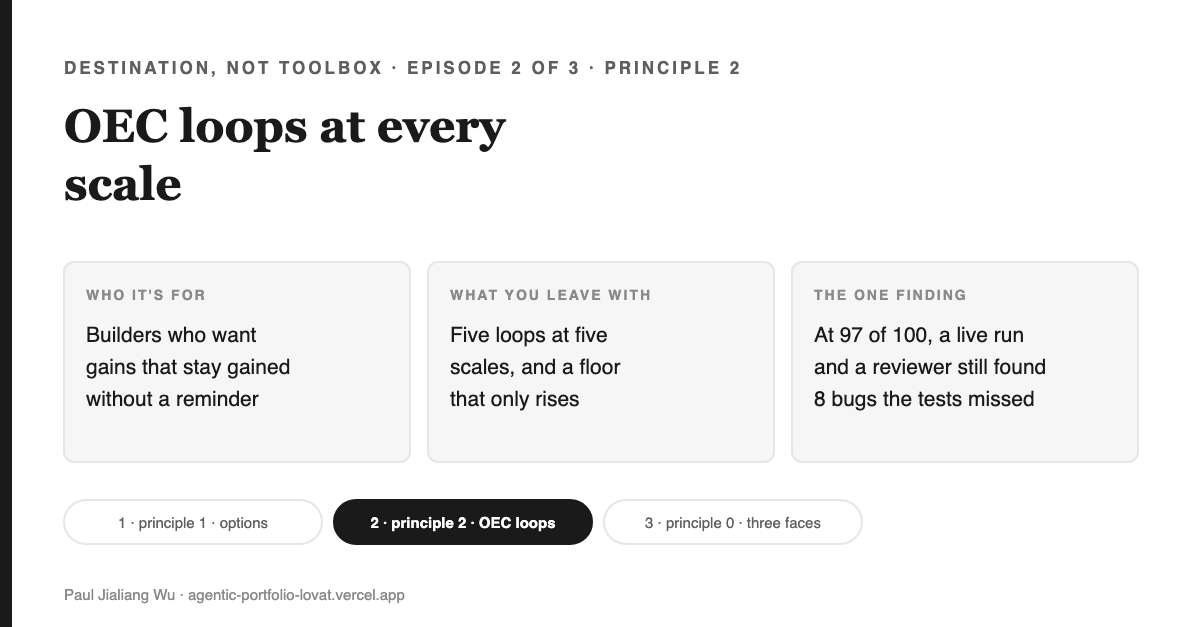
What this is. An essay and a playground for builders about OEC loops (observe, evaluate, control) and why the same loop has to run at every scale: seconds, minutes, a pull request, a week, a month. It is built on a codebase that graded itself from 65 to 97 out of 100 and refused its own regressions, and still needed a live run and an outside reviewer to catch what its tests could not; fixing those took it to 98.
Why it matters. Most improvement decays because it depends on someone remembering. A loop that observes, evaluates against a bar decided in advance, and acts (by feedback after an error, or by feedforward before one) keeps the gain without a reminder. Teams and products fail the same way codebases do, so the same loops transfer.
What you can do after reading. Pick one system you own. Name one loop at each of five scales (seconds to a month), write one feedforward tripwire with a date, and try to sneak a change past the quality floor in the playground.
Destination, Not Toolbox — the series spine
▶ See it running: open the live demo public · no sign-in
- Agentic software hands you options episode 1
- OEC loops at every scale this episode
- Truth, love and beauty: one system episode 3
The one question: How does a system keep improving after it ships, without anyone remembering to improve it?
This piece does NOT explain what the system is for or why its centre is a human choice; that is part 1. Why truth, love and beauty keep each other alive inside these loops is part 3.
What this essay is about: OEC loops, and why one is never enough
This is an essay about OEC loops: observe, evaluate, control. It is about how a system keeps getting better after it ships, without anyone having to remember to improve it. It is written for builders who have watched a clean codebase, a good team habit or a careful plan decay within a month. You need a browser, a pen, and about forty minutes.
The story comes from the same codebase as part 1: a self-hosted office for a small founding team, run as code. In September it went from an empty folder to a system that grades itself. Its own scorer measured it at 65 out of 100 on the first day and 91 the next. By late October it scored 97, and it had refused its own regressions on the way. Then a live run and an outside reviewer still found eight bugs that every one of its tests had missed; fixing them took it to 98. Both halves of that story are the lesson.
The principle under this essay is the second of the series, which I call cross-scale, cross-dimension OEC. Observe, evaluate and control at every scale at once (seconds, minutes, days, weeks, months; a line of code, a team, a budget), and at every dimension of what you measure (a single number, a line through time, a table, a structure, and the same loop repeating inside itself). One loop at one scale is a scoreboard. A stack of loops is a system that corrects itself.
Part 3, Truth, love and beauty are one control system, asks what keeps all these loops honest, and reads the three principles of the series on one system.
The cooking ladder from part 1 carries this essay too, because it is already a ladder of scales. Every level of a kitchen runs the same three steps, just on a different clock.
| Cooking level | Observe | Evaluate against | Control |
|---|---|---|---|
| The cook, seconds | taste the spoon | the recipe | add salt now |
| The pass, minutes | look at the plate | the house standard | send it back |
| The head chef, a new dish | taste it cold, from outside | what the menu promised | change the dish before it ships |
| The weekly menu meeting | what sold, what came back | last week's targets | one change next week |
| The chain, a quarter | every restaurant's numbers | limits set in advance | change the plan |
Before you read on. You will end by helping one teammate build a five-scale loop table for something they own. Read as someone who will have to explain the difference between feedback and feedforward with a pen. In a meta-analysis of 39 studies, teaching after studying with that expectation scored g = 0.48 (a subgroup result), while teaching without it showed no measurable benefit (g = −0.02) (Kobayashi (2024), Educational Psychology Review (ERIC EJ1414484)).
Activity 1 · Balance a pen on your palm
Stand up. Balance a pen or a pencil upright on your open palm for ten seconds. Then do it again while you walk slowly across the room.
Before reading on, write down two things. What did your eyes watch, and when did your hand move? And what changed when you started walking?
Standing still, you watched the tip and moved your hand after it started to tip. That is feedback: there must be an error before you correct it. Walking, you probably leaned your hand forward before the pen tipped, because you knew you were about to move. That is feedforward: acting on a plan or a known disturbance before any error appears. Control engineers say both in one line. Åström and Murray write that "Feedback is reactive: there must be an error before corrective actions are taken." and describe acting on a known disturbance in advance: "This way of controlling a system is called feedforward." (Åström & Murray (2020), Feedback Systems: An Introduction for Scientists and Engineers, 2nd ed., v3.1.5, §1.2). Their verdict on which to use is the whole of this essay in miniature: "Experience indicates that it is often advantageous to combine feedback and feedforward" (Åström & Murray (2020), Feedback Systems, 2nd ed., §1.2).
The three verbs, and the one that gets skipped
In one sentence: an OEC loop observes a measured state, evaluates it against a standard decided in advance, and controls the next action, at every scale at once.
An OEC loop has three steps. Observe: measure the state, with a sensor you trust. Evaluate: compare it with a standard decided before you looked. Control: act on the difference. The idea is old. Norbert Wiener named a whole field after it in 1948: Cybernetics, subtitled "Cybernetics, or control and communication in the animal and the machine" (Wiener (1948), Cybernetics: Or Control and Communication in the Animal and the Machine (Open Library work OL4307531W)).
In practice the step that gets skipped is the third. I wrote this in an earlier essay, and it is still the most common failure I see: "evaluation without a control hook is just a scoreboard" (Wu, P. J., The App That Audits Itself). A dashboard nobody acts on is observation without control. A review that finds problems nobody fixes is evaluation without control. Both feel like discipline. Neither changes anything.
Control comes in two kinds, and you need both. Feedback corrects after an error. Feedforward acts on a plan before the error: a rule, a limit or a tripwire written down in advance, with a date and the action it triggers. Feedback alone is always late. Feedforward alone is blind to surprises.
One loop, five scales
Here is the same loop at five scales of time, with the failure in the office's codebase that taught each one.
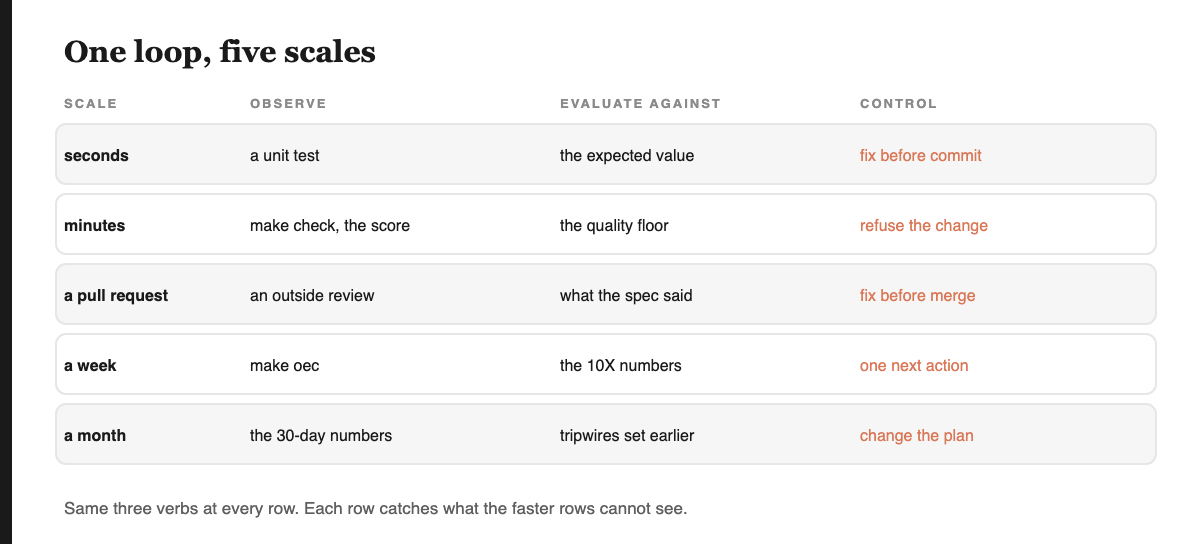
Seconds: the unit test. Each test observes one value, evaluates it against the expected one, and blocks the commit. It is the fastest loop and the most fooled. The tests in this codebase used a fake file drive that accepted any upload. The real drive refuses to save a file into a folder that does not exist. Every offline test passed; the first live run failed. A fast loop only sees what its fake can see.
Minutes: the ratchet. Every change runs one command that measures the code (documentation, function size, nesting, typing, tests) into one score, and compares it with a ratchet: a floor stored in a file that only moves up. A change below the floor is refused. After a real gain the floor is raised, and lowering it requires a written decision. In its first session the ratchet caught a bug in its own rounding, a README badge that no longer matched the measured score, and a drop to 90 caused by the very file that implemented the weekly loop. The loop's first run reported the regression its own code had introduced.
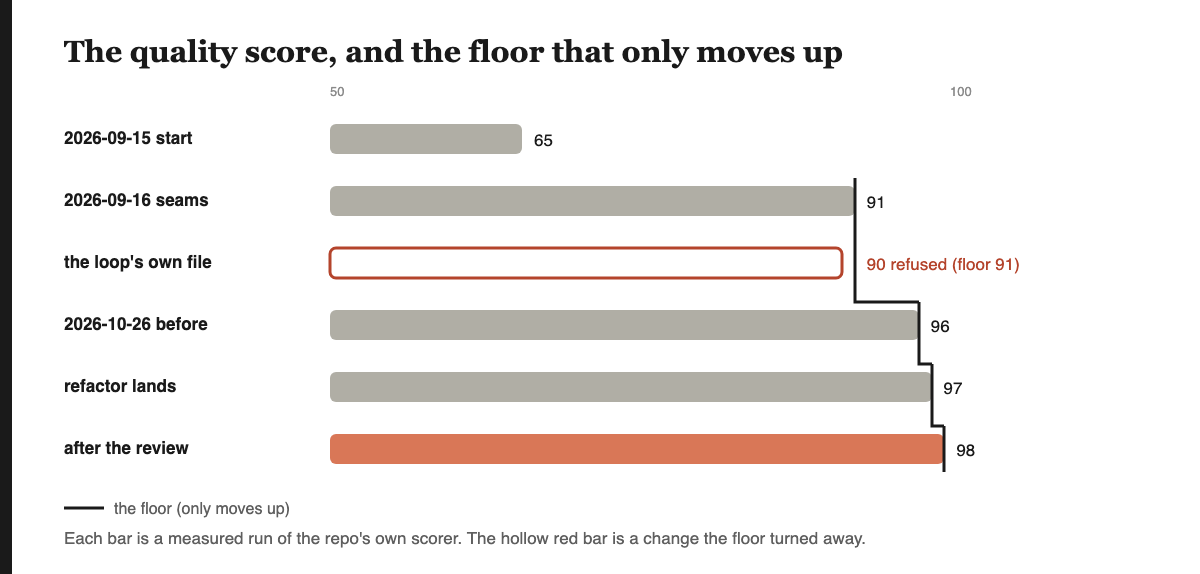
A pull request: the outside reviewer. Before the October rebuild merged, a separate reviewer read the new code cold. It found seven real bugs the tests had missed. The best one: an old version of a function was still defined further down the same file, so it silently replaced the fixed version above it. The new test written for that bug failed on the first run, which is how I found the duplicate. My earlier essay says why the reviewer has to be someone else: "a loop that scores its own work does not get better — it gets more confident." (Wu, P. J., Loop Engineering Is a Referee).
A week: the observation loop. Once a week one command observes everything that matters (the gate, the floor, whether generated documents are stale, whether anyone outside this laptop can reach the office, how old the newest backup is, and now how many decisions are waiting for a human) and prints exactly one next action. If the same action comes up three weeks running, it says so. A repeated action is a blocked loop, not a to-do. This loop once exposed a quieter failure: the self-improvement engine I use with my coding agents had logged 111 runs and promoted zero lessons to its always-on memory. It was recording, not compounding.
A month: tripwires. The October rebuild shipped with dated tripwires. If no decision goes through the new loop by 9 November, decision speed was not the bottleneck, and I ask the team before building more. If the human agrees with the machine's first option less than a third of the time after ten decisions, the objective is mis-stated. These were written before any data existed, which is the point. A tripwire decided after you see the result is a rationalisation.
Activity 2 · Draw your five scales
Pick one thing you own: a codebase, a habit, a team ritual, a household budget. Draw a five-row table: seconds, minutes, a change, a week, a month. In each row write what you observe, what you compare it with, and what you do about it.
Circle every empty "control" cell. Each one is a scoreboard pretending to be a loop.
Most people find two kinds of gap. The slow rows are empty because nobody owns them; the fast rows have no outside eye because the author is the reviewer. Filling one cell in each kind usually does more than adding a sixth metric.
Dimensions: from a number to a fractal
Scale is how often you look; dimension is the shape of what you look at — a dot, a line, a table, a wiring diagram, or the loop itself. A system that only measures one shape has a blind spot exactly the size of the others.
| Dimension | What it observes | In this codebase | What it misses alone |
|---|---|---|---|
| 0, a point | one number | the quality score, 98 | how it got there |
| 1, a line | a number through time | every scored run, in order | why it moved |
| 2, a plane | a table of measures × items | the scorecard: five metrics, each offender by name | how the parts connect |
| 3, a structure | which part may depend on which | a test that fails if the core imports any add-on | how the shape changes |
| 4, structure in time | how the shape changes across versions | not measured here yet: nothing compares one version's dependency graph with the last | slow drift between versions |
| fractal | the same loop inside the loop | test → check → review → week → month | nothing at this level; it is the stack |
The last row deserves its name. Benoit Mandelbrot showed that a coastline's measured length depends on the length of your ruler, and gave the paper the subtitle "Statistical Self-Similarity and Fractional Dimension" (Mandelbrot (1967), How Long Is the Coast of Britain? Statistical Self-Similarity and Fractional Dimension, Science 156(3775), 636-638). A system's quality is like that. Measured with a one-second ruler (a unit test) it looks smooth. Measured with a live run or an outside reader, new detail appears that the short ruler could not resolve. The loops are self-similar: the same three verbs at every scale. That is what makes the stack work. Each level catches what the faster level is too fine or too fooled to see.
The trap in every measure
A loop is only as honest as its sensor, and a measure that becomes the goal stops being a good sensor. The usual wording is Marilyn Strathern's, from 1997: "When a measure becomes a target, it ceases to be a good measure." (Strathern (1997), 'Improving ratings': audit in the British University system, European Review 5(3), 305-321, as quoted by Wikipedia, Goodhart's law). Goodhart's original 1975 sentence was about economic statistics: "Any observed statistical regularity will tend to collapse once pressure is placed upon it for control purposes." (Goodhart (1975), Problems of Monetary Management: The U.K. Experience, as quoted by Wikipedia, Goodhart's law). Strathern's own abstract adds the sharper warning: "audit does more than monitor—it has a life of its own that jeopardizes the life it audits." (Strathern (1997), European Review 5(3), 305-321).
The ratchet in this codebase has exactly that weakness, and it says so in its own scorecard. Its "tested" number is test functions divided by production functions. It is not coverage. Four trivial tests would raise it. Naming that on the page is the cheapest defence I know: a gate that overclaims is worse than no gate, because it buys false confidence.
The opposite failure is a gate nobody has ever seen fire. My essay on the andon cord says it plainly: "a gate that has never fired is indistinguishable from a gate that cannot fire" (Wu, P. J., ANDON: Pull the Cord). Toyota's version is physical. On its production line "the operator can stop the line by pulling the stop cord themselves" (Toyota Motor Corporation, Toyota Production System (global.toyota)). A loop earns trust the first time it stops something. Every gate in this codebase has a test that feeds it a planted violation and expects it to fail.
Activity 3 · Write one tripwire
For the system you drew in Activity 2, write one tripwire in this exact form: "If [measure] is [above/below] [number] by [date], then I will [action]."
Then write the one observation that would tell you the tripwire itself is wrong.
The form forces the three verbs. The measure is the observation, the number and date are the standard decided in advance, and the action is the control. The second sentence is the loop on the loop: a tripwire you cannot imagine being wrong is a belief, not a control.
Activity 4 · Try to sneak past the floor
Open section 5 of the Destination Playground. Ship a change at 92, then raise the floor. Now try to ship one at 70.
Look for the button that lowers the floor. Predict why it is not there before you read on.
There is no lower-the-floor button, on purpose. In the real codebase lowering the floor is possible, but it means editing a file and writing a decision entry that says why. That friction is the feedforward half of the ratchet: it is decided in advance that a red build is fixed by fixing the code, not by moving the bar. What is real in the playground: the rule. What is made up: the scores.
Same story, five exits
| You are a… | The decision this changes | One action this week |
|---|---|---|
| Student | How you study for something that matters | Add one feedforward rule (a date you test yourself) to your feedback (marked homework) |
| Engineer | Which loop your codebase is missing | Find the empty control cell in your five-scale table and fill it |
| Founder | How you know the team's habits are holding | Write three dated tripwires for this quarter before the numbers arrive |
| Executive | Whether a dashboard is a loop | Ask, for every chart, what action it triggers and who takes it |
| Investor | Whether a company's quality will hold after the demo | Ask to see a gate that fired, and what it stopped |
Truth, love and beauty in this essay
- Truth: the scores are the repo's own measurements, the bugs are real ones with the test that found them, and the weakness of the main metric is stated on the page.
- Love: every loop here exists so that a teammate, or a future me at 2 a.m., does not have to remember. A gate is a kindness to the person who would otherwise be blamed for forgetting.
- Beauty: one three-step loop, repeated at every scale and dimension. Nothing new has to be invented to add a scale.
One lens is my own, and I label it as mine. The apostle Paul's letter to the Philippians ends with an instruction about what to observe: "Finally, brothers, whatever things are true, whatever things are honorable, whatever things are just, whatever things are pure, whatever things are lovely, whatever things are of good report; if there is any virtue, and if there is any praise, think about these things." (Philippians 4:8, World English Bible). In my faith that is feedforward for a person: choosing in advance what you will pay attention to, before the day decides for you. The loops above stand without that belief.
Mistakes that are half right
- "More metrics mean more control." More observation without a control step is a bigger scoreboard.
- "Tests prove it works." Tests prove it works on their fakes. A live run at the user's level is a different sensor.
- "A floor that only rises makes people game the score." It can. Naming what the score cannot see, and pairing it with an outside reviewer, is what keeps the floor honest.
- "OEC loops are about not failing." Mostly. But the ratchet also raises the bar after every real gain, so the same loop that prevents loss also locks in growth.
Principles I had been using without naming them
Rereading my earlier essays for this series turned up four principles I had applied many times and never named. Each one is a piece of cross-scale OEC.
- A rule stored as prose decays; a rule that can stop something holds. "a rule in prose is enforced by whoever remembers it" (Wu, P. J., ANDON: Rules as Data). That is the control step made physical.
- A check that has never failed tells you nothing. "A smoke detector with a dead battery makes exactly the same sound as one that works" (Wu, P. J., Silence Is Not a Status). That is the observe step applied to the sensor itself.
- Decide what would change your mind before you look. That is feedforward, and it protects evaluation from hindsight.
- Whoever made it does not grade it. That is the evaluate step with an outside eye.
Now teach it
Your teach-back. Sit for fifteen minutes with one teammate. Hand them a pen and do Activity 1 together. Then help them fill a five-scale table (Activity 2) for something they own, and write one dated tripwire with them (Activity 3). If they have not read part 1, start there: a loop needs a destination before it needs a floor.
Outcome: your teammate can explain feedback and feedforward with the pen, without notes, and has one tripwire with a date on their calendar. Post the tripwire (without private details) as a comment on this article.
Why it matters: five whys
The problem: a codebase that scored 97 out of 100 and passed every test still had a bug its first live run found in seconds, and seven more an outside reviewer found before the merge.
- Why did the tests miss them? The tests observed the code through a fake drive that was kinder than the real one, and through the author's own idea of what could go wrong.
- Why was that enough to score 97? The score is a single number from one scale. It measures the code's shape, and its own scorecard admits that its test metric is not coverage.
- Why did the slower loops catch what the fast ones did not? A live run and a cold reader are different sensors, with longer rulers. Mandelbrot's coastline is the picture: new detail appears at a new scale (Mandelbrot (1967), How Long Is the Coast of Britain? Statistical Self-Similarity and Fractional Dimension, Science 156(3775), 636-638).
- Why do teams skip the slower loops? Slower loops cost hours and a second person, and nothing goes red when they are skipped. A skipped review leaves no trace in any dashboard.
- Root cause: quality was treated as a property measured at one scale, instead of a stack of observe-evaluate-control loops at every scale, each with a sensor the faster ones do not have. The fix is the stack, with feedforward tripwires written before the data.
Operate: run it this week
- Read the teach-ahead line.
- Balance the pen standing and walking (Activity 1, 3 minutes).
- Draw your five-scale table and circle the empty control cells (Activity 2, 10 minutes).
- Write one dated tripwire and the observation that would prove it wrong (Activity 3, 5 minutes).
- Try to sneak a change past the floor in the Destination Playground (Activity 4, 5 minutes).
- Teach it to one teammate and post the tripwire.
Feedback: how you know it worked
- Every row of your five-scale table has a control cell, and at least one row has an outside eye.
- At least one gate you own has been seen to fail on a planted problem.
- On your tripwire's date, you did what it said, or you wrote down why not.
What this cannot see: whether your standards were the right ones. Loops hold a system to its standard; they do not choose it. That is part 1's job (the destination) and part 3's (what keeps the standard honest).
Feedforward: tripwires, decided now
- If a metric moves and nobody changes anything, delete the metric or add the control step. A scoreboard costs attention and returns nothing.
- If the same next action comes up three weeks running, escalate it. It is blocked, not forgotten.
- If you want to lower a floor to make a build pass, write the decision first. If you cannot write it, fix the code.
The 5S self-score
| S | Claim | Evidence |
|---|---|---|
| Simple | The prose reads at a grade-12 level or easier; one three-step loop carries the essay. | Flesch–Kincaid grade: 7.0 (band ≤ 12), recomputed by node scripts/check-numbers-four-ages.mjs --series agentic-collab |
| Solid | The control-theory claims come from the textbook; the measure trap keeps its true author. | "Experience indicates that it is often advantageous to combine feedback and feedforward" (Åström & Murray) |
| Sharp | Each scale catches what the faster scale is too fine or too fooled to see. | five scales · dimensions |
| SMART | This week: one table, one dated tripwire, one teammate taught. | Operate |
| Surprise | The loop's first run reported a regression caused by the loop's own code. | the ratchet |
| Truth · Love · Beauty | Measured scores with their weakness named; gates as kindness; one loop at every scale. | Truth, love and beauty |
Sources
- Åström, K. J. & Murray, R. M. Feedback Systems: An Introduction for Scientists and Engineers, 2nd ed. (electronic version Version v3.1.5 (2020-07-24)). caltech.edu
- Wiener, N. (1948). Cybernetics, or Control and Communication in the Animal and the Machine. Open Library
- Mandelbrot, B. (1967). How Long Is the Coast of Britain? Statistical Self-Similarity and Fractional Dimension. Science 156. Crossref
- Strathern, M. (1997). 'Improving ratings': audit in the British University system. European Review 5. OpenAlex
- Goodhart's law, with Goodhart's 1975 wording and Strathern's phrasing. wikipedia.org
- Toyota. Toyota Production System. global.toyota
- Kobayashi, K. (2024). Interactive learning effects of preparing to teach and teaching. Educational Psychology Review. ERIC EJ1414484
- Philippians 4:8, World English Bible. bible-api.com
- Wu, P. J. The App That Audits Itself. agentic-portfolio
- Wu, P. J. Loop Engineering Is a Referee. agentic-portfolio
- Wu, P. J. ANDON: Pull the Cord. agentic-portfolio
- Wu, P. J. ANDON: Rules as Data. agentic-portfolio
- Wu, P. J. Silence Is Not a Status. agentic-portfolio
- The Destination Playground (this series' running demo). agentic-portfolio